
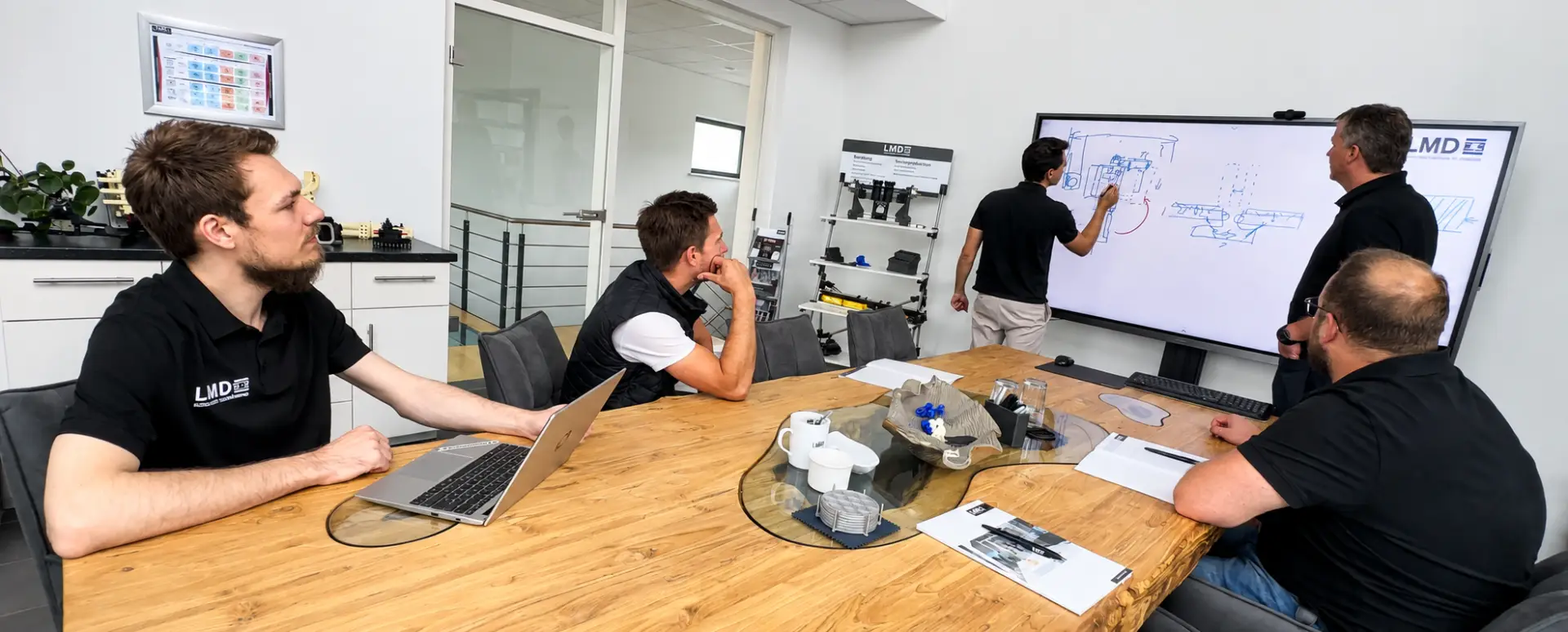
Developing tailored
solutions together.
It doesn’t start with the manufacturing process, but with your task.
Every industrial challenge is different. That is why at LMD we do not start with a particular technology but with understanding your application, your requirements and your goals.
We combine technical know-how with creative thinking and experience from a range of industries. The result is individual solutions that work technically, make economic sense and prove themselves in practice.
From initial consulting through development and design to manufacturing, assembly and integration, we support you exactly where you need us.
For us, standards are the foundation – but not a limit. Driven by our ambition to think in new ways, we develop solutions precisely where no suitable approaches exist on the market and technical limits have been reached.
Every development follows a structured and certified process. This ensures that your application is tailored exactly to your requirements from the first idea to the finished solution and that risks are minimised at an early stage.
Based on a comprehensive analysis, we first develop a function-integrated concept. This forms the basis for the design and implementation of your customised solution.
Challenges in design engineering.
Additive manufacturing has long ceased to be a new process. Nevertheless, in many cases there is a lack of basic understanding of how to design components for manufacturability and fully exploit the potential of the technology – particularly because these topics are often still barely covered in conventional training.
Additive manufacturing will not replace existing processes, but complements them as a further tool for finding solutions. The right mindset is crucial: function integration, freedom of geometry and moving away from conventional component thinking are at the heart of our workshops.
Our goal is to increase your efficiency sustainably – through well-thought-out design, function-integrated solutions and the targeted use of additive manufacturing.
- Lack of functional thinking
Components are considered in isolation rather than as an integrated solution within the overall process - Insufficient use of design freedom
Potential such as function integration, lightweight design and complex geometries remains untapped - Transfer of conventional design principles
Components are designed as if for machining rather than optimised for additive manufacturing - Excessive complexity in assemblies
Many individual parts lead to greater assembly effort and a higher risk of errors - No cost-effectiveness assessment
Additive manufacturing is not used specifically where it creates real added value - Insufficient process perspective
The focus is on the individual component rather than its function within the entire production process